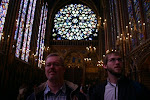
Tomorrow is our last full day in Paris, after which Heather and I part ways with my parents and grab a train to Strasbourg. Heather hasn't been home since March, and I think she's more or less ready to see the States again. Still, I think this should be a good trip.
Some highlights from Paris... we saw Victor Hugo's house, the Pantheon (which contains among other things Foucault's pendulum and the aforementioned author's remains), Saint-Sulpice, the Eiffel Tower (of course), and Saint Chapelle. We viewed a large amount of impressionist and realist art at the Musee d'Orsay, and today we spent a few hours at the Louvre (where I could have spent a week). We also saw the Opera Garnier, which is the opera house that inspired Leroux to write the Phantom of the Opera (the French book, not the musical). It has subterranean water and everything. Tomorrow we're catching an early train to Versailles.
The pinnacle of the trip for me, however, was our visit to Notre Dame Cathedral. The cathedral itself was spectacular, and not just because of its associations with Victor Hugo's Hunchback of Notre Dame. After touring the inside of the sanctuary we climbed the tall spiral staircase up to the first landing at the base of the two towers, right near the entry to the belfry where the fictional Quasimodo made his home.
There is a belfry at the base of each of the two towers of Notre Dame, one containing a full complement of cathedral bells and the other a single, gargantuan bell. While wandering around the top of the cathedral, amidst the gargoyles and chimeras, the bells began to sound. The clamor was enormous, almost to the point of being painful; the vibrations could be felt across the entire stone edifice. They sounded for a good fifteen minutes, and those fifteen minutes overlooking Paris and listening to the bells of Notre Dame were the best fifteen minutes of this trip.
In my opinion.
Thursday, June 19, 2008

Saturday, June 14, 2008
Traipsing the Old World
Heather has officially finished her term in Oxford, and thanks to her study abroad-ing and my father's hoard of frequent flyer points the whole family is over here now to visit the university town with her. It was great meeting some of the UGA students she studied with. And it was obviously cool to see the colleges, shops and pubs of Oxford. Several of the pubs we've eaten at are older than the U.S. The majority of them, actually. Just to put things in perspective.
Being here gives one strange ideas about graduate work abroad, though the cost would be prohibitive. Especially at 2 dollars per pound. Though they have a great D.Phil program in Development studies, with focuses in Economic Development, Anthropological Research, Forced Migration...
Anyway, we're off to Paris tomorrow from whence Heather and I will be hitting hostels across Europe.
Tuesday, May 20, 2008
Monday, May 12, 2008
Hell in a Handbasket?
"For the Time Being"
Annie Dillard
---
Is it not late? A late time to be living? Are not our heightened times the important ones? For we have nuclear bombs. Are we not especially significant because our century is? —our century and its unique Holocaust, its refugee populations, its serial totalitarian exterminations, our century and its antibiotics, silicon chips, men on the moon, and spliced genes? No, we are not and it is not. These times of ours are ordinary times, a slice of life like any other...
There were no formerly heroic times, and there was no formerly pure generation. There is no one here but us chickens, and so it has always been: a people busy and powerful, knowledgeable, ambivalent, important, fearful, and self-aware; a people who scheme, promote, deceive, and conquer; who pray for their loved ones, and long to flee misery and skip death. It is a weakening and discoloring idea, that rustic people knew God personally once upon a time—or even knew selflessness or courage or literature—but that it is too late for us. In fact, the absolute is available to everyone in every age. There never was a more holy age than ours, and never a less. There is no less holiness at this time—as you are reading this—than there was the day the Red Sea parted, or that day in the thirtieth year, in the fourth month, on the fifth day of the month, as Ezekiel was a captive by the river Chebar, when the heavens opened and he saw visions of God.... In any instant the sacred may wipe you with its finger. In any instant the bush may flare, your feet may rise, or you may see a bunch of souls in a tree. In any instant you may avail yourself of the power to love your enemies; to accept failure, slander, or the grief of loss; or to endure torture. Purity's time is always now.
Thursday, April 24, 2008
And then school was over
"My Utmost for His Highest"
Oswald Chambers
------
We are apt to imagine that Jesus Christ constrains us and when we obey Him, He will lead us to great success. We must never put our dreams of success as God's purpose for us; His purpose may be exactly the opposite. We have an idea that God is leading us to a particular end, a desired end; He is not. The question of getting to a particular end is a mere incident. What we call the process , God calls the end.
What is my dream of God's purpose? His purpose is that I depend on Him and on His power now. If I can stay in the middle of the turmoil calm and unperplexed, that is the end the purpose of God. God is not working toward a particular finish; His end is the process-- That I see Him walking on the waves, no shore in sight, no success, no goal, just the absolute certainty that it is all right because I see Him walking on the sea. It is the process, not the end, which is glorifying to God.
God's training is for now, not presently. His purpose is for this minute, not for sometime in the future. We have nothing to do with the afterwards of obedience; we get wrong when we think of the afterward. What men call training and preparation, God calls the end.
God's end is to enable me to see that He can walk on the chaos of my life just now. If we have a further end in view, we do not pay sufficient attention to the immediate present: if we realize that obedience is the end, then each moment as it comes is precious.
Monday, March 31, 2008
Benefits of Off-Campus Life
None of the roommates has class on MWF mornings, so this morning all of us (Wilson, Dan, James, and myself) got up at 7:30 and ran a few miles. And by a few I mean 2; it's a start. After cooling down we all hung out in the kitchen and made bacon and chocolate chip pancakes. Which almost certainly offset all the health benefits of the run. All together, though, it made for a great morning. I'm not usually a morning person, but it always feels good to get an early start to the day.
In other news, I should hear this week from both ECHO in Florida and (potentially) the organization in Nairobi that has my resume. I'm probably equally excited about both opportunities: if I get a "yes" from both organizations I will have a tough decision ahead of me. On the other hand, if I get a "no" from both organizations I'm not sure where I'll turn to.
David Scott called me a couple of nights ago to say that he was looking into moving into an immigrant area of downtown Atlanta, and either working for a non-profit in the city or just getting a normal job and focusing on cross-cultural relationships for about a year. He suggested that if I don't have any plans, I should live with him. I'm thinking about it. If Kenya and ECHO both fall through, I will think about it even harder.
Tuesday, February 26, 2008
Still here... biding time...
"...he is, of course, absurdly young--not twenty-one--and he will be engaged to be married at twenty-three. He has no knowledge of the world; for example, he thinks that if you do not want money you can give it to friends who do. He believes in humanity because he knows a dozen decent people. He believes in women because he has loved his mother. And his friends are as young and as ignorant as himself. They are full of the wine of life. But they have not tasted the cup--let us call it the teacup--of experience, which has made men of Mr. Pembroke's type what they are. Oh, that teacup! To be taken at prayers, at friendship, at love, till we are quite sane, quite efficient, quite experienced, and quite useless to God or man. We must drink it, or we shall die. But we need not drink it always. Here is our problem and our salvation. There comes a moment--God knows when--at which we can say, 'I will experience no longer. I will create. I will be an experience.' But to do this we must be both acute and heroic. For it is not easy, after accepting six cups of tea, to throw the seventh in the face of the hostess."
~E.M. Forster, The Longest Journey
For all his oft-times muddy social critiques, I cannot seem to get enough of E.M. Forster. Which is unfortunate, because if Wikipedia is to be trusted (and indubitably it is) I have now read almost everything he ever published.
This is becoming a difficult semester, due not to an abundance of work but to a complete lack of motivation. It's not that I want to be lazy, but rather that other things feel so much more important than my classwork. The people I see daily now but mayn't see again after May; the Lookout Mountain moonlight dripping through heavy fog is more enticing by far than the desk covered in work sheets that stands between tonight and graduation. Even the collection of Dostoevsky short stories that has, unopened, adorned my desk these past weeks feels more urgent than my daily reading for Science class and my looming research papers.
On the other hand, I'm in no hurry to graduate and leave this place. It's a dangerous business, going out your door. And it's almost time for my class to step out onto the road and see where it sweeps us off to.
Subscribe to:
Posts (Atom)